
Insights on Shopify,
Development & Digital Craft
Deep dives into modern commerce architecture, performance engineering, and the technical decisions that drive revenue.


Shopify's Translation Tool Adds Auto-sync: What Still Needs Review
Use Shopify Translate & Adapt Auto-sync with a two-product check that separates automatic updates from manual review, plus eligibility and correction steps.

Before You Commission Shopify App Development
Choose between Shopify Flow, a supported app, and custom development using plan checks, a warehouse retry demonstration, and clear maintenance responsibilities.

Shopify Apps to Increase Sales: What to Install First
Choose sales apps around a specific buying obstacle, compare Shopify's native options, and test variants, discounts, cart behavior, and fulfillment before launch.

Shopify Theme Editor: From Product Preview to Published Page
Learn Shopify theme editor scope, when to use metafields or alternate templates, and how to publish a product layout that previews correctly but cannot yet be assigned.

Shopify Fraud Prevention Before an Order Leaves Your Store
Connect Shopify fraud analysis, payment capture, and fulfillment holds into a tested review process—including split shipments and orders without recommendations.

Which Shopify Store Login Page Changes Need an App?
Choose native settings, theme work, customer-account apps, or Plus identity integration for your Shopify login page—and test where shoppers land after sign-in.

Understanding Shopify Cart Abandonment and What to Do Next
Separate Shopify funnel losses, saved checkout records, and customers eligible for reminders. Find purchase barriers, test shipping fixes, and verify recovery emails.

Choose Your Shopify Banner Image Size in Pixels
Choose Shopify banner dimensions from your theme's image area. Calculate mobile cropping, understand Dawn's second image, and check resolution before exporting again.

Shopify vs Squarespace for Your Online Store
Compare Shopify and Squarespace by inventory, POS stock updates, local-currency checkout, and shipping eligibility. Decide when staying makes more sense than migrating.

Shopify Sitemap Generator: Find the File and Check What’s Missing
Shopify generates your sitemap automatically. Find the XML file, investigate missing products, and separate visibility settings from Google indexing problems.

Best Shopify Apps for Dropshipping, Chosen by Order Workflow
Compare DSers, Shopify Collective, Syncee, DropCommerce, and Printful, then test mixed-cart shipping, partial fulfillment, cancellations, and returns before expanding.

Which Shopify Migration Tool Fits Your Store?
Choose a Shopify migration tool by the records you need, then test relationships, changed records, duplicate prevention, and historical-order side effects.

Selling Shopify Multi-Currency Gift Cards: A Merchant's Guide
Set up Shopify multi-currency gift cards with native tools, understand purchase and redemption limits, and test cross-border gifts before promoting them.

Update Shopify Customer Accounts Without Losing Customer Benefits
Update Shopify customer accounts with a practical release checklist for order history, loyalty eligibility, subscriptions, store credit, and sign-in testing.

Shopify SEO Tools: What Our Audit Numbers Actually Measure
Our audit snapshot reveals why duplicate-copy and missing-alt percentages need context. Learn what Shopify SEO tools measure before authorizing bulk changes.

Shopify Chargeback Protection Depends on How You Fulfill
Decide whether Shopify Protect is enough by separating ineligible orders, fulfillment failures, and uncovered dispute reasons before adding another fraud app.

Does Your Shopify Page Speed Booster Help the First Visit?
Test direct landings and collection-to-product clicks separately to find out whether a Shopify page speed booster adds value beyond native prefetching.

Shopify Google Analytics Code: Where It Goes and How to Verify It
Set up Shopify GA4 through Google & YouTube, find existing tracking code, and verify each event with an order-level record before removing duplicate integrations.

Shopify Flower Shop Setup: Delivery, Pickup, and Date Rules
Build a Shopify flower shop around orders you can fulfill: configure delivery and pickup, choose scheduling rules, and test bouquets with add-ons across checkout paths before launch.
Appstle Subscriptions vs. Shopify's Native Subscriptions: What Actually Changes for Your Store
Appstle Subscriptions is a capable, well-reviewed way to run subscriptions on Shopify, but it's built on the same Selling Plans and Cart Transform Functions that ship with Shopify itself -- which means some of what gets blamed on the app is actually a platform limit that follows you to any subscription app you switch to. Here's what each pricing tier actually buys you, the specific Cart Transform operation Shopify blocks the moment a selling plan is attached, and how to tell whether you need a paid app at all.
What a Shopify App Detector Can Actually See on a Store (and What It Can't)
A Shopify app detector reads the public parts of a storefront -- script tags, injected widgets, DOM signatures -- and matches them against a database of known apps. That works for reviews widgets and upsell popups, but it structurally cannot see anything that runs on Shopify's servers instead of in the visitor's browser, which is most of what a serious operation actually depends on. Here's how the detection method works, the two different ways it gets a result wrong, and how to read what it tells you.
Why Your Shopify Cart Transform Function Stops Working the Moment a Customer Subscribes
A Cart Transform bundle that works perfectly on a one-time purchase can vanish the instant the same line carries a subscription option -- not because of a bug in your code, but because Shopify rejects the operation outright once a selling plan is attached to that line. Here's the exact operation-level breakdown of what Cart Transform can touch, which single operation actually requires Shopify Plus, and why installing a second app's transform can silently change what the first one sees.
How to Turn Off Your Shopify Store for the Season Without Losing Your Google Rankings
The option that keeps your rankings safest for a multi-week closure isn't the one most guides default to, and the reason has nothing to do with the setting's name and everything to do with how Shopify's redirect system and Google's crawler actually behave once a page stops responding. Pause and Build, private mode, and full deactivation each fail differently -- here's which one to use for a two-week close versus a six-month one, and the specific redirect trap that erases work you did months ago the moment you reopen.

Shopify's Duties Calculator Runs on Two Fields You Probably Left Blank
Shopify's native duties calculator only ever produces two kinds of numbers: an accurate one, built from a product's HS code and country of origin, or a guess built from its title and category when either field is missing -- and your checkout never tells the customer which one they got. This is the two-field test that predicts it before a parcel gets stopped at the border, why a correct HS code from six months ago can still produce the wrong number today, and the specific point at which a paid duty app starts earning its fee over the free native toggle.
A Shopify 'ChatGPT Plugin' Is a Chat Widget, Not What Gets Your Products Into ChatGPT Shopping
Every app on the Shopify App Store marketed as a "ChatGPT plugin" is an on-site chat widget for your own storefront -- it has nothing to do with whether your products show up when someone shops inside ChatGPT itself. That second thing is a separate, free, native Shopify feature called Agentic Storefronts, and most eligible US stores have had it switched on automatically since March 2026 whether they installed an app or not. Here's what each one actually does, how to check what's turned on in your own admin, and when the paid chat widget is worth adding anyway.
Do You Need a Shopify Store Locator App, or Does Settings > Locations Already Cover It?
Most Shopify merchants selling through retail partners, dealers, or more than a couple of owned locations need a dedicated store locator app, because Shopify's own "list this location as a physical store" setting only gets you listed inside the Shop app, not a searchable map on your own site. Here's what the free option actually covers, what the popular apps cost and don't do, and the inventory-sync gap none of the app comparison roundups mention.
Shopify's AI Store Builder Isn't Broken. It's Just Not on Your Desktop Anymore.
Merchants searching "shopify ai store builder not working" almost always have the same problem: Shopify moved free AI theme generation to the Shopify mobile app and mobile browser only, and the desktop admin quietly stopped offering it. Here's exactly where the tool lives now, the plan and language restrictions that block some stores from it entirely, the support gap Shopify documents but nobody blogs about, and when the honest answer is to skip it and hire a developer instead.
Meta Just Joined Shopify's Agentic Storefronts. Here's What Its Listing Quality Score Misses.
Meta joined Shopify's Agentic Storefronts admin as a supported AI sales channel on September 8, 2026, syncing your catalog to it by default. The bigger story is one click over: a new Listing Quality score for that same catalog, and our own audit of 58 Shopify stores says the data most merchants would fail on -- duplicate descriptions and missing alt text -- doesn't register on Shopify's own meter at all. Here is what actually changed, which toggle controls what, and the two catalog fixes worth doing before an AI agent starts recommending your products.
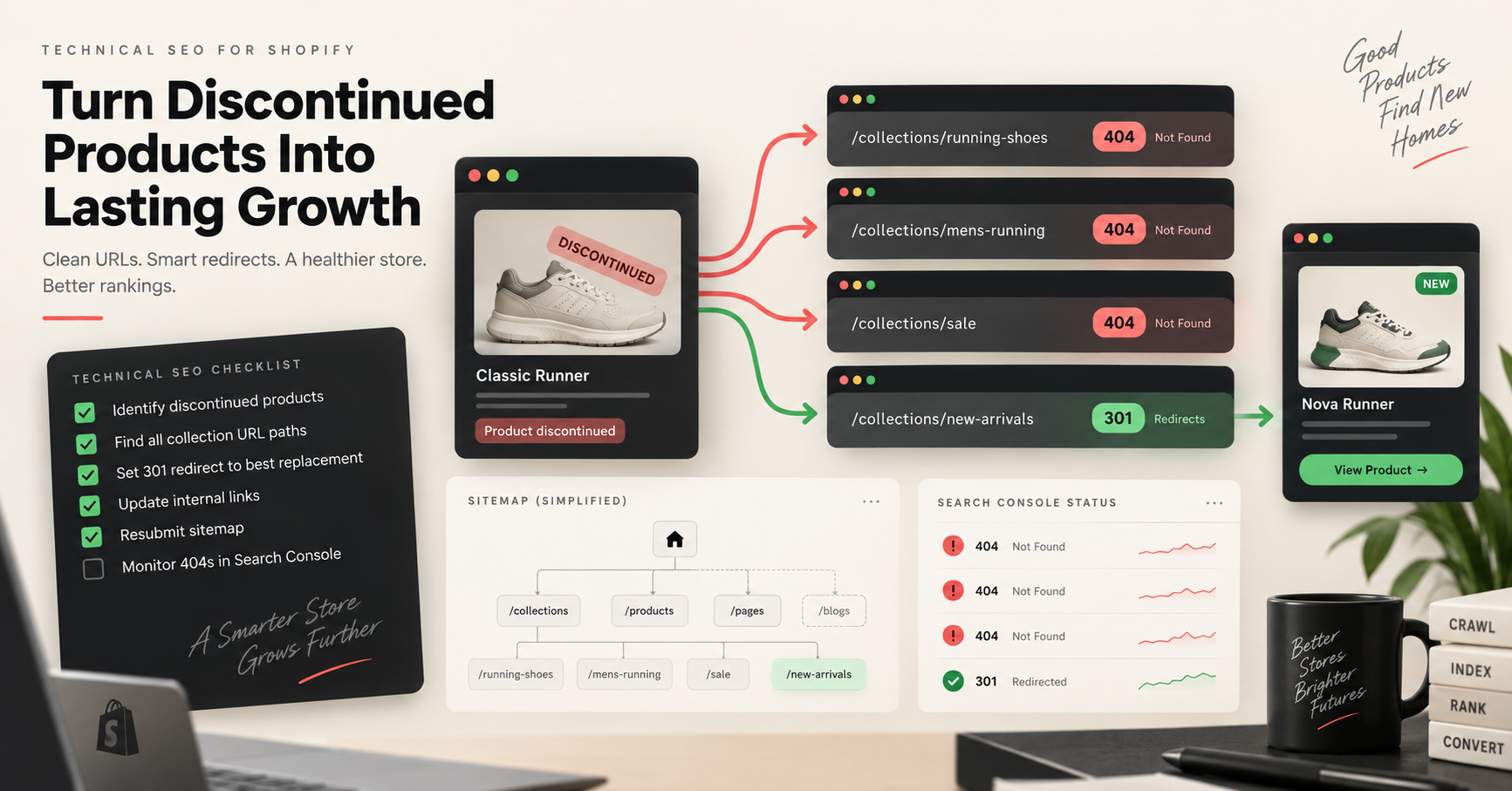
Shopify Discontinued Product 404s Are Not Always an SEO Emergency
Deleting one Shopify product can create several Search Console 404s because Google may have indexed collection-specific product URLs as well as the canonical /products/ URL. The fix is not to redirect everything to the homepage. Here is the decision rule: redirect only URLs with a close replacement or real demand, leave honest 404s when the product is truly gone, and remember that Shopify redirects only work after the old URL is actually broken.
Shopify Variants Can Finally Hold Multiple Barcodes. The GraphQL API Just Can't Read Them Yet.
As of September 2026, a Shopify product variant can carry up to 20 barcodes instead of one, so a UPC, a private-label EAN, and a marketplace ASIN can all live on the same variant. The admin lets you add them today. The stable GraphQL Admin API — the version any production app or integration is actually built against — still only reads and writes the old single barcode field, and Shopify hasn't said exactly when that changes. Here's the version distinction almost nobody covering this has explained, the actual field names, and what happens to an integration that doesn't know the second barcode is there.
Shopify Markets vs. Expansion Stores: Pick Markets First, and Know Exactly When to Leave It
Start every international expansion on Shopify Markets, not Expansion Stores — Markets is free on every plan, needs no new contract, and its SEO is handled for you inside one store. Expansion Stores are a Shopify Plus feature for a narrower set of cases: a genuinely separate storefront, catalog, or brand experience per region, and only for store types Shopify's organization admin actually recognizes as "expansion" stores. Here's the eligibility rule that trips people up, the cross-domain SEO work every comparison skips, and why there's no clean way back once you've split.
Why Does Shopify Say a Product's Inventory Isn't Tracked?
"Not tracked" means Shopify's Track quantity setting is off for that specific variant, so it behaves as unlimited stock — nothing decrements on a sale and it won't appear in low-stock alerts. Most of the time that's a checkbox fix. The case every other guide skips is the one where a fulfillment app already owns that variant's tracking, and Shopify's own API locks the toggle so clicking it in your admin does nothing at all.
Shopify Payments Test Mode Has a Turn-Off Step Almost No Guide Mentions
Shopify Payments test mode lets you run practice orders with fake card numbers before you go live, and Shopify's own instructions cover turning it on in about four lines. What they don't cover — and neither does almost anything else ranking for it — is what happens to the orders you create while it's on, whether the apps already connected to your store treated them as real, and how to actually clean up before launch day.
Shopify Customer Accounts Default to a shopify.com Domain — Connecting Your Own Takes More Than a CNAME Record
Every Shopify store's new customer accounts open on a shared shopify.com URL until you connect a subdomain of your own, and the admin panel makes that look like a five-minute DNS change. It usually is — until the store runs its DNS through Cloudflare's proxy, or has already wired up a third-party identity provider whose settings point at the domain you're about to replace. Neither failure mode shows up until a customer can't sign in.
Fixing Poor LCP on Shopify Starts With a Setting Your Theme Already Got Wrong
Most "shopify poor lcp" advice repeats the same three lines — compress images, use WebP, lazy-load everything. The actual cause on most Online Store 2.0 themes is narrower: Dawn, Craft, and Sense apply loading="lazy" to image banner sections without checking whether that section renders first, which quietly lazy-loads the exact image Google is timing.
The Shopify App Uninstall Webhook Cleans Up Less Than Merchants Assume
Shopify automatically removes an uninstalled app's script tags and theme app extension blocks — that part is genuinely clean. What it doesn't touch is metafields the app wrote, code pasted directly into theme.liquid, and the mandatory "shop/redact" webhook only erases the app's own database, not anything sitting in your store.
Shopify Pixel Helper vs. Meta Pixel Helper: They're Not the Same Tool
The Chrome extension most "shopify pixel helper" guides describe doesn't exist — Shopify's Pixel Helper is a testing dialog built into Settings > Customer events, and it only checks one pixel at a time. That single limitation is exactly why duplicate, double-counting pixel installs go unnoticed on so many stores.
Do You Need a Shopify Migration Agency, or Can You Do the Move Yourself?
DIY migration tooling costs $0-$1,000 and an agency runs $1,500 to $250,000+, so the honest answer isn't a price comparison — it's whether your catalog, your organic traffic, and your in-house time can absorb the risk of getting redirects wrong. Here's the break-even math nobody selling migration services actually shows you.
Why Your Shopify Payout Balance Never Matches What You Expected, and What the New Activity Report Actually Shows You
Your Shopify Payments balance and the deposit that actually lands in your bank account are almost never the same number, and until August 22, 2026 there was no single report that showed why. The new Payments activity report lays out starting balance, gross activity, fees, payouts, and ending balance for a date range in one place — here's how to read it, the five things it will usually catch, and when a gap means an actual hold rather than normal timing.
What Shopify Flow Templates Actually Automate, and When You Need a Custom App Instead
Shopify Flow's template library covers order tagging, low-stock alerts, and risk flags out of the box, but its connector list covers a small slice of the App Store and it has no scheduled trigger — so most real automation needs run out of template road within a week. Before you build a custom app, there's a middle step almost every guide skips: the Send an HTTP request action, which reaches any endpoint you control without one. Here's where templates stop, where that action picks up, and where you actually hit the Plus-only wall for custom triggers.
We Scanned 58 Shopify Stores and Found 18% of Inventory Hasn't Sold in a Year
Across the 58 Shopify stores in our free scanner's corpus, 18% of live, in-stock products haven't recorded a single unit sold in the past twelve months — still active, still linked from a collection page, still counted in inventory value. Shopify has no report called "dead stock," but the pieces to build one are already sitting in Analytics, and almost every guide pointing merchants toward a paid app skips past them.
Meta and Microsoft Ads Conversion Tracking on Shopify: What the UET Iframe Warning Actually Means
Shopify's Web Pixels sandbox runs every custom pixel inside an iframe, and Microsoft Ads' own UET Tag Helper flags that as a warning the moment you install a UET tag through Customer Events — sending merchants chasing a fix for a problem that, on its own, usually isn't one. Here's what the warning actually means, what's really causing missed Microsoft Ads and Meta conversions on Shopify, why Campaign Autopilot doesn't solve it, and the server-side fix that holds up at real ad spend.
Shopify Customer Accounts Don't Support Login With Email and Password. Here's What Actually Works Instead.
New Shopify customer accounts are passwordless by default, and there is no admin setting that turns a classic password field back on. The top-ranking answer to this question — switch to classic accounts — stopped working for most stores after Shopify deprecated legacy accounts on February 26, 2026. Here are the three options that actually exist now, what each one costs to set up, and which stores should skip which.
DHL Express Just Landed in Shopify's Admin for the UK and EU. Here's What It Doesn't Do.
Shopify merchants shipping from the UK, Germany, France, Italy, or Spain can now buy DHL Express labels straight from the admin, no app and no monthly fee. What the changelog and the recap posts don't say clearly enough: it's still early access, it never touches what a customer sees or pays at checkout, and pairing it with Managed Markets' new DDP default is where stores actually start losing margin if the shipping profile isn't updated to match.
Why Your Shopify 'On Hand' Inventory Never Matches What's Available to Sell
On hand is everything you have at a location; available is what's left after subtracting anything committed to an order or held back for another reason — and the two numbers almost never match. The blog posts that explain this stop at a three-way split. They miss the four unavailable states Shopify's API has tracked separately since 2023, the CSV column split that quietly broke import scripts in August 2025, and the fact that the admin's own product screen still only shows you the rolled-up total.
The Shopify Migration Checklist That Covers What's Actually Changed in 2026
A migration checklist that only covers exporting data, mapping 301 redirects, and testing checkout is the same one agencies have been recycling since 2019 — and it leaves out four platform changes that can break a store on launch day: Checkout Extensibility, the mandatory new Customer Accounts system, Managed Markets' new duties default, and the Collections model that changed in July 2026. We checked five of the top-ranking migration checklists and Shopify's own official one. None of them mention any of the four.
Should You Hire a Shopify Speed Optimization Service, or Will an App Fix It?
A speed app can compress images, lazy-load below-the-fold content, and defer non-critical scripts — and that closes maybe a third of what's actually slowing a typical Shopify store. It cannot rewrite a Liquid loop fetching metafields nobody sees, cannot reduce the number of separately-loaded app scripts fighting for main-thread time, and cannot touch code baked into your theme.liquid. Here's the ten-minute diagnostic that tells you which category your store is actually in, before you spend $20/month or $2,000 finding out the hard way.
Shopify Now Lets You Combine Two Discounts on One Line Item — But Only on Plus
Shopify's GraphQL Admin API can now apply two separately-created product discounts to the same cart line instead of only the better one winning — a capability Shopify Scripts used to provide and nothing has replaced since Scripts stopped running in June. The part almost every article covering this skips: it's gated to Shopify Plus, there is no admin dashboard toggle anywhere, and it only works through a tag-matching field both discounts have to reference correctly. Here's exactly how the mechanism works, the GraphQL you actually need to write, and what a non-Plus store should do instead of searching for a setting that doesn't exist for them.
Shopify Multi-Currency: When Markets' Native Conversion Is Enough, and When It Isn't
Shopify's built-in multi-currency, through Markets, is free on every plan from Basic up and requires only Shopify Payments — no app needed to display and sell in local currencies. Where it runs out is control: you cannot set a custom rounding rule, cannot price a SKU manually per market without switching off automatic conversion entirely, and cannot get paid out in the customer's currency unless you're on Advanced or Plus. Here's exactly what the native tool does, the three places it structurally can't do more, and how to tell which one you're actually hitting before you pay for an app to fix it.
We Scanned 56 Shopify Stores and Found 19% of Product Images Have No Alt Text
Across the 56 Shopify stores in our free scanner's corpus, 19% have at least one product image with no alt text at all — not weak alt text, none. That is a Google Images ranking signal you are leaving blank, and it is also the single most litigated accessibility gap on ecommerce sites right now: missing image descriptions are exactly what a screen reader has nothing to read out. Here is how common it actually is, the three ways to fix it in bulk, and the CSV re-import mistake that erases other fields while you're at it.

Shopify's "Hide Out of Stock Products" Feature Doesn't Hide Them From Google
Shopify's built-in "hide out of stock products" trick only removes a product from one collection's grid — the page itself stays Active, stays in the sitemap, and stays exactly as indexable as it was in stock. Across the 56 stores in our free scanner's corpus, 18% have products that are completely sold out and still published this way. Here's what actually removes a page from Google (it isn't Draft, and it isn't the collection condition everyone reaches for first), the admin filter that finds every one of them in bulk, and the GraphQL mutation that does it at scale.
Why Shopify Still Shows "Translation Missing" After You've Translated Everything
"Translation missing" survives a full pass through Translate & Adapt because Shopify splits store content into layers that don't share one translation queue — theme strings, product/page resource content, metafields, and metaobjects each need their own pass, and one of them silently excludes any field that isn't set to public Storefront API access. Here's the layer you skipped, the exact admin path to check it, and the GraphQL query that finds what Translate & Adapt's own dashboard doesn't show you.
Shopify Payments vs. Stripe: The Fee Math and the Countries Where You Don't Get a Choice
In most countries, Stripe isn't a real alternative to Shopify Payments — it only appears as an option where Shopify Payments isn't supported at all. If you already qualify for Shopify Payments, the actual decision isn't which processor is better; it's whether paying an extra surcharge of up to 2% on top of a separate processor's own rate buys you anything, and for most stores it doesn't. Here's the eligibility rule, the current fee table by plan, and the two narrow cases where routing around Shopify Payments is genuinely worth it.
Shopify Customer Accounts Now Support Your Own Identity Provider — But Only If It Returns a Refresh Token
Shopify Plus stores can replace the default customer accounts sign-in with their own OpenID Connect identity provider — Okta, Auth0, Entra ID, or a homegrown one. It's a real, generally available feature, and it's also easy to configure in a way that quietly cuts every customer's session from Shopify's usual 90 days down to whatever your provider's access token lasts, sometimes one hour. Here's what the setup docs don't warn you about, and who should actually build this.

Shopify Flow Triggers: Why Multiple Events, Manual Runs, and Webhooks Don't Work the Way the Docs Imply
Shopify Flow allows exactly one trigger per workflow — there's no setting that lets a single workflow start from two different events. A manual trigger already exists inside the admin, and you can fire a workflow from an outside webhook without paying for a connector app. Here's how each piece actually works, since the reference docs bury the one-trigger rule and every existing webhook-trigger guide is a paid app's marketing page.
We Scanned 55 Shopify Stores and Found 39% Have Duplicate Product Descriptions
Across the 55 Shopify stores in our free scanner's corpus, 39% have at least one product description that duplicates another page word for word — either another product in the same catalog or supplier copy indexed somewhere else on the web. Google doesn't penalize this; it consolidates it, picks one page to show, and the rest stop existing in search results. Here's how to tell which of your duplicates are actually costing you rankings, and which are harmless.
Do You Need Google Tag Manager for GA4 Ecommerce Tracking on Shopify, or Is the Native Integration Enough?
Shopify's native Google & YouTube channel sends a real GA4 ecommerce event set with no code and no Google Tag Manager container. It also never fires two events most merchants assume they're getting, runs browser-side only, and Shopify's own setup docs don't say any of this. Here's exactly what the native path tracks, what it misses, and the three specific situations where GTM or a paid app is worth the added complexity.
WooCommerce to Shopify Product Import: CSV, Migration App, or Custom Script
A bare Shopify CSV import will take your WooCommerce products, but it silently drops anything past 3 variant options, leaves WordPress shortcodes sitting raw in your descriptions, and can re-issue every variant ID the moment you re-import — breaking any subscription or loyalty app keyed to the old ones. Here's what each of the three real migration paths actually preserves, and which one fits a catalog like yours.
Why Your Shopify Speed Test Score Changes Depending on Which Tool You Run
Run the same Shopify store through PageSpeed Insights, GTmetrix, and Shopify's own admin, and you can get three different numbers — sometimes 40 points apart — without anything being broken. Each tool measures something different: a synthetic run on a fixed connection, or real visitor data collected over weeks. Only one of those is what Google actually uses to rank you, and it usually isn't the one merchants stare at first.
Shopify Will Decide Your Duties Setting for You on August 24 — Unless You Opt Out of Managed Markets First
If your store uses Shopify Managed Markets, every market that still ships delivered-duty-unpaid switches to delivered-duty-paid automatically on August 24, 2026 — no setup required, no error if you do nothing. The only decision is whether you want that default, and Managed Markets is a narrower, separate product from the plain duties toggle in Settings > Markets, which means this changelog item may not even apply to you.
Shopify Purchase Orders Have No GraphQL API: Build Your Own Tooling, or Buy an App?
Shopify's native purchase orders in Products > Purchase orders can record a supplier, quantities, cost, and status — but as of the 2026-07 Admin API release, there is still no PurchaseOrder object, query, or mutation anywhere in GraphQL or REST, a gap developers have been filing feature requests against for over a year with no resolution. With Stocky gone for good on August 31, that leaves anyone who assumed the native feature was scriptable with three real choices, and the 'alternatives' roundups don't mention any of them.
We Scanned 52 Shopify Stores and Found Weight-Based Shipping Rates Wrong on Nearly 4 in 10
Across 52 Shopify stores we scanned, 39% had at least one physical product with no weight set — and Shopify's checkout adds a missing product's weight as zero, not as a warning, so the order simply ships at whatever your default package weighs. That quietly undercharges every heavy item and can zero out a weight-based rate tier entirely. Here's how to find every affected product and the one case where a blank weight field is actually correct.

Do You Still Need an llms.txt File on Shopify Now That agents.md Is Canonical?
Shopify generates an agents.md file for every store automatically, and since late May 2026 agents.md — not llms.txt — is the canonical AI-discovery document; your store's /llms.txt and /llms-full.txt URLs just mirror it unless you override them. So the search-bar question has a short answer: you already have one. What's worth twenty minutes is checking what the default actually says, and knowing the three Liquid templates that let you change it when the managed version genuinely isn't enough.
How the Shopify ChatGPT Integration Actually Works Now That Instant Checkout Is Gone
ChatGPT can no longer complete a purchase from your Shopify store — OpenAI quietly rolled that back in March 2026, about six months after launching it with Shopify as a pilot partner. What's live today is a referral flow into your normal checkout, while Google AI Mode, Gemini, Microsoft Copilot and Meta actually do check a customer out inside their own chat window if you turn it on. Here's exactly what each channel does right now, where the admin toggle lives, and the real (narrower than you'd think) reason most of that in-chat buy button is still US-shopper-only, even for stores based in the UK, Australia or Canada.
Shopify Customer Login Not Working? Here's Why It's Almost Never a Bug
When a shopper can't log in to your Shopify store, the cause is almost never Shopify being down — it's a verification code that never arrived, got blocked, or expired before they used it. Here's the actual list of causes for the passwordless customer accounts system, in the order to check them, and why Shopify's own troubleshooting guide won't help because it's written for your admin login, not your customers'.
Shopify's GraphQL Payouts Query Silently Drops Payouts Once You Have More Than One Business Entity — Here's the Reconciliation Fix
If your books stopped matching Shopify's payout numbers right around the time you added a second Market or legal entity, the cause probably isn't your bookkeeping — it's the query. Querying shopifyPaymentsAccount.payouts at the top level of the GraphQL Admin API only returns payouts for your primary business entity; anything paid out through a second or archived entity vanishes from the response with no error and no warning. Here's how to confirm you're affected, the corrected query, and how to reconstruct history you already lost.
Shopify Auto-Migrated Every Address Blocker Rule in July — Some Didn't Survive, and Non-Plus Stores Just Got the Feature for Free
Shopify quietly migrated every store's Checkout Blocks Address Blocker rules to a new address format validation checkout rule by the end of July 2026, ahead of the Address Blocker's August 31 sunset. The migration was automatic and mostly silent — some rule types, like requiring a street number, aren't supported in the new system and simply didn't come across. Here's how to check what your store actually has active right now, and why non-Plus stores should read this too: the replacement reached every plan, not just Plus.
Shopify Deprecated the deliveryProfile API on August 1 — Your Shipping App's Writes Now Succeed and Do Nothing
Shopify quietly deprecated the merchant-owned deliveryProfile queries and mutations on August 1, 2026, for any shop with market-driven shipping enabled. Reads can return a stale snapshot and writes can return success with zero effect on live rates — no error, no webhook, nothing in the API response to tell a custom app it just shipped a no-op. Market-driven shipping starts rolling out to every merchant on October 1. Here's how to check if you're affected and what the replacement APIs actually look like.
Shopify's orderUpdate Mutation Starts Recalculating Taxes on Address Changes August 31 — Here's What It Breaks
Changing a shipping address on an existing Shopify order through the orderUpdate mutation used to leave the original tax lines untouched, which is why so many integrations built a manual orderEditBegin workaround just to get accurate tax after an address correction. Starting August 31, 2026, orderUpdate recalculates taxes automatically on unfulfilled orders — and does not on partially fulfilled ones. That split behavior is the part that will break address-correction tools, fraud/AVS fixes, and accounting reconciliation nobody has re-tested yet.
Shopify Deletes Custom Checkout Fields on August 26 — 'Just Build a Checkout Extension' Doesn't Work Below Plus
Every non-Plus Shopify store loses checkout.liquid and the Additional Scripts box on August 26, 2026, taking any custom checkout field with it. Checkout UI Extensions are the advertised fix, but the extension points that render inside the actual checkout steps are Plus-only. Here's the field-collection method that survives the deadline on every plan.
Stocky Shuts Down August 31, 2026: Export Your Purchase Orders Now, Because Suppliers Can't Be Exported at All
Shopify's own inventory app, Stocky, stops working completely on August 31, 2026 — four weeks from today. Historical purchase orders and stocktakes don't move to Shopify automatically, and supplier records can't be exported at any point. Here's what to pull out before the deadline and what actually replaces Stocky's reorder logic.
De Minimis Is Dead and Your Shopify Store Still Ships DDU: Why US Orders Keep Getting Refused at the Door
The $800 exemption that let low-value parcels into the US duty-free ended on August 29, 2025. A year on, most Shopify stores that ship internationally still have duty collection switched off, so the bill lands on the customer's doorstep instead of at your checkout — and the parcel comes back to you.
I Scanned Allbirds and Gymshark With My Own Tool. Both Are Losing Money in the Same Place, and It Is Not the Home Page
Every free Shopify audit tool reads your home page and stops. That is the one page you have already looked at a thousand times. The expensive problems are sitting in your product catalogue, which Shopify publishes publicly and almost nobody reads.

Why Your Shopify Products Are Invisible to ChatGPT and Perplexity Shopping — and the Two Fixes That Actually Matter
Shopify's Winter '26 Agentic Storefronts push made ChatGPT, Perplexity, and Microsoft Copilot shopping a live channel, and AI-referred orders are already growing roughly 11x year over year. Most merchants who try to check whether they show up find nothing — not because their catalog is bad, but because a leftover robots.txt block or an incomplete Product schema is quietly keeping every AI shopping agent out. Here's how to find and fix both.
Shopify's inventorySetQuantities Mutation Now Requires an Idempotency Key — Here's Why Your Inventory Sync Started Failing
If a custom app, 3PL integration, or Shopify Flow automation writes inventory through the inventorySetQuantities mutation and started throwing invalid-value errors sometime after API version 2026-04 went live, the cause is almost always the same: the idempotency key that was optional in 2026-01 became mandatory in 2026-04. Here's what changed, why Shopify made it required, and the exact mutation shape that fixes it.
Horizon Is Now Shopify's Default Theme, and Its Blog Has No Real Pagination — Here's Why That's Costing You Search Traffic
Horizon replaced Dawn as the default theme for new Shopify stores in 2026, and its blog section ships with infinite scroll and nothing else — no page numbers, no ?page= URLs, no pagination setting like collections got. Merchants with more than 50 posts are finding older content effectively invisible to Google, because Googlebot can't scroll. Here's the audit and the Liquid fix.
Google Merchant Center Suspended Your Shopify Store for "Misrepresentation"? Here's the Audit That Actually Finds the Trigger
Merchants are getting Google Merchant Center and Google Ads accounts suspended for "Misrepresentation" with no specifics — just a generic checklist and an escalating cooldown between appeals. The suspension is rarely one big issue; it's usually a handful of Shopify-specific gaps in business identity, checkout price transparency, and policy pages. Here's the audit to run before you burn another appeal.
Shopify Payments Payouts Frozen and 'Verify Identity' Won't Launch? The Session Bug Merchants Keep Hitting, and How to Actually Escalate It
Merchants are reporting Shopify Payments payouts paused for weeks to months over identity verification — some because the 'Verify identity' button spins and never opens a session, others because documents were submitted and simply sit 'in review' with no team confirmed to own the case. Here's what actually causes each pattern, and the specific questions that get support to move.

The EU Withdrawal Button Deadline Already Passed on June 19 — Why Shopify's Self-Serve Returns Don't Satisfy It, and How to Build One That Does
Since June 19, 2026, EU consumer law (Directive 2023/2673) requires stores selling to EU customers to offer a clearly visible, login-free electronic withdrawal function with a two-step confirmation and an automatic durable-medium receipt. Shopify's native self-serve returns run through Customer Accounts, which requires login — so most stores are still out of compliance without realizing it. Here's what the law actually requires and how to build a flow that meets it.
Shopify Merchants on Standard Plans Are Losing Chargebacks Over Terms-of-Sale Proof — Here's the Evidence Trail You Can Build Without Plus
Banks are increasingly rejecting chargeback disputes unless merchants can show a timestamped record that the customer saw and agreed to their terms of sale before paying — evidence Shopify's hosted checkout doesn't generate by default, and that customizing the checkout page to fix directly requires Plus. Here's how to build a real consent trail on any plan, and where the gap still exists on accelerated checkout.
Shopify's Fake Abandoned Checkout Bots Are Corrupting Your Customer List and Analytics: A Containment Plan
Since early 2025, waves of bots — merchants have nicknamed one recurring pattern "James James" — have been creating tens of thousands of fake customers and abandoned checkouts on Shopify stores, wrecking email deliverability, GA4 conversion data, and ad attribution. Shopify has not shipped a platform-level fix. Here's a concrete Shopify Flow and email-hygiene plan to contain the damage.

Shopify's 128KB JSON Metafield Limit Is Breaking Page Builders and Product Customizers: How to Audit and Fix It
Shopify capped JSON metafield writes at 128KB starting with API version 2026-04, down from 2MB. Page builders, bundle configs, and 360° spin data are hitting the wall with a confusing 'value exceeds maximum size' error. Here's how to find which fields are at risk and fix them before your next API upgrade.
Shopify Legacy Customer Accounts Are Deprecated: Rebuild Your Login Popup, Custom Fields, and Order Page Before Support Ends
Shopify deprecated legacy customer accounts on February 26, 2026. Here's what actually breaks — custom login popups, registration fields, account page branding — and how to rebuild it with Customer Account UI extensions before the final sunset date.
Shopify Scripts Stopped Executing on June 30: Find Your Silently Broken Discounts, Shipping, and Payment Rules
Shopify Scripts stopped running on June 30, 2026 with no error message. Here's how to audit what broke, migrate to Shopify Functions, and rebuild before the Script Editor itself disappears on July 30.
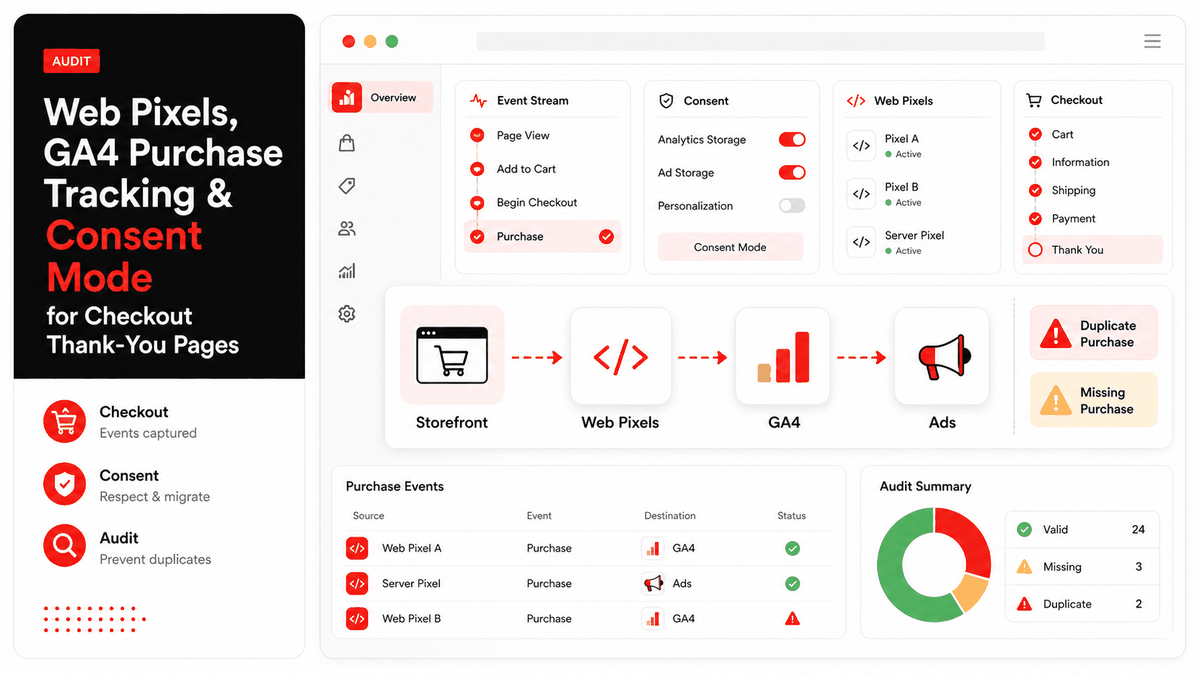
Shopify Web Pixels and GA4 Consent Mode: Fix Purchase Tracking Before Thank You Page Scripts Break
Migrate Shopify Additional Scripts to Web Pixels without losing GA4 purchases, duplicating conversions, or breaking consent-aware checkout tracking.
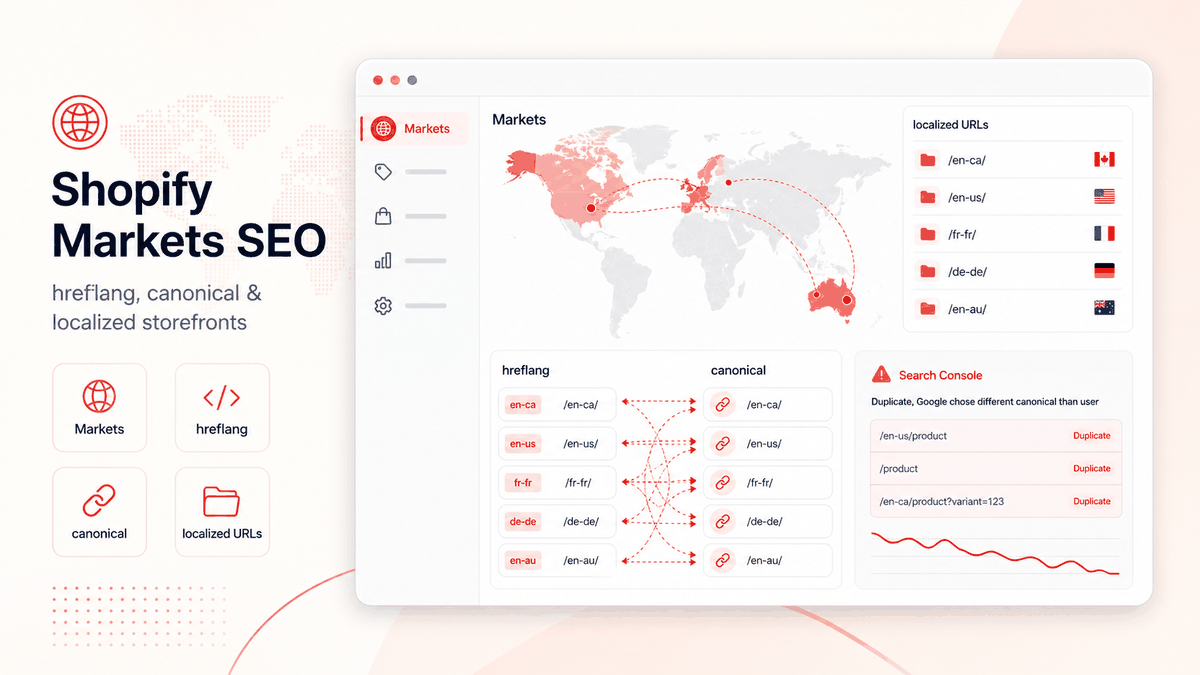
Shopify Markets Hreflang and Canonical SEO Architecture for International Stores
Fix Shopify Markets duplicate URL signals with clean localized routes, self-referencing canonicals, hreflang validation, and market-aware Liquid patterns.
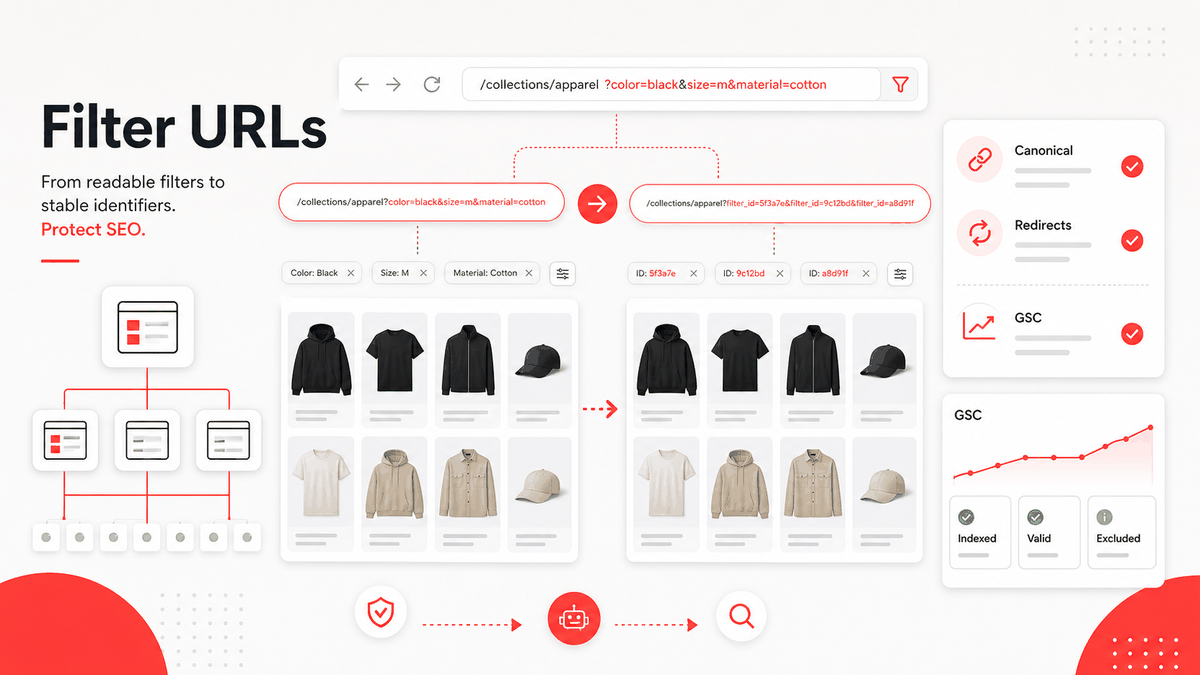
Shopify Filter URL Stable Identifier SEO Migration: Protect Indexed Facets and Campaign Links
Audit Shopify filter URLs after the 2026 stable identifier change, preserve valuable indexed facets, and prevent Search Console parameter bloat.

Shopify Checkout Customization: From Basic Tweaks to Checkout Extensibility
Learn how to customize Shopify's checkout experience using Checkout Extensibility, branding options, and advanced techniques to maximize conversions.

Migrating to Shopify from WooCommerce or Magento: A Complete Guide
Planning to migrate your online store to Shopify? This complete guide covers data migration, SEO preservation, theme recreation, and avoiding common pitfalls.
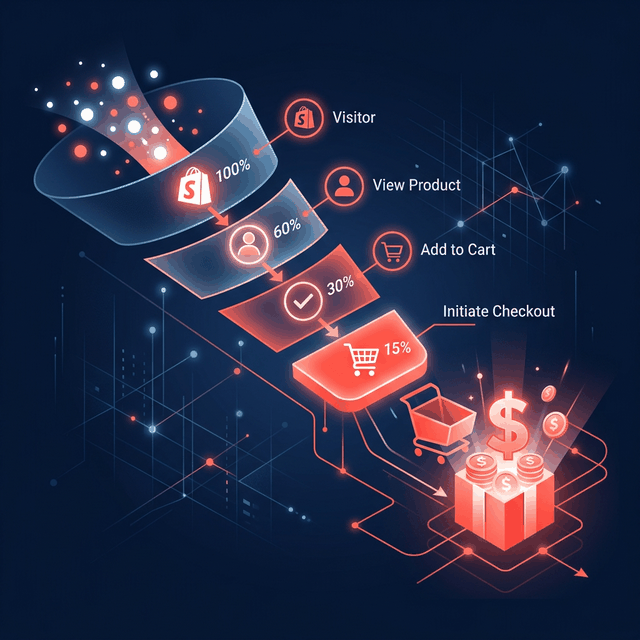
Shopify B2B Catalog Pricing Integrity: Stop Null Compare-at Prices and Tier Rule Drift
Fix Shopify B2B catalog price drift, null compare-at values, and tier break mismatches with GraphQL pricing controls and audit routines.

Headless Shopify with Hydrogen: Building the Future of E-Commerce
Explore headless Shopify development using Hydrogen and React. Learn when headless makes sense and how it delivers blazing-fast custom storefronts.
10 Proven Shopify Conversion Rate Optimization Strategies for 2026
Increase your Shopify store's conversion rate with these 10 proven CRO strategies covering checkout optimization, trust signals, and UX improvements.
Shopify Multi-location Inventory Race Condition Playbook
Prevent Shopify overselling from concurrent inventory writes with compare-and-set updates, idempotent webhooks, and reconciliation jobs.

Mastering Shopify Liquid: A Developer's Guide to Theme Customization
Dive deep into Shopify's Liquid templating language. Learn objects, filters, tags, and advanced techniques for building custom Shopify themes.

Shopify Store Speed Optimization: The Ultimate Performance Guide
Learn how to dramatically improve your Shopify store's loading speed with proven optimization techniques that boost both user experience and Google rankings.

The Complete Guide to Shopify SEO: Rank Higher on Google in 2025
Master Shopify SEO with this comprehensive guide covering technical SEO, on-page optimization, content strategy, and structured data implementation.

Shopify 2048 Variants Architecture: Solving the 3-Option Ceiling Without Killing UX
Use a scalable product architecture for Shopify’s 2048-variant model while handling the persistent 3-option limit with clean UX and SEO structure.

Why Shopify is the Best Platform for E-Commerce in 2025
Discover why Shopify remains the leading e-commerce platform and how it can help you scale your online store with expert guidance from Code Kaarigari.
Shopify GraphQL Bulk Operations for Large Catalog Sync: 2026 Playbook
Scale Shopify catalog sync beyond count/query limits with bulk operations, JSONL pipelines, throttle-safe writes, and failure recovery.
Shopify Filtered Collection SEO Architecture: Scale Facets Without Index Bloat
Build Shopify filtered collection SEO architecture that preserves crawl budget, avoids facet bloat, and keeps high-intent landing pages indexable.

How to Hire the Right Shopify Expert for Your Business
Looking for a Shopify expert? Learn what to look for when hiring a Shopify developer and how Code Kaarigari delivers results-driven Shopify solutions.
Shopify CLS/LCP Triage for App-Heavy Themes: Liquid and Script Surgery
Fix Shopify CLS and LCP regressions caused by Liquid over-fetching and app scripts with template-scoped loading, media guards, and budgets.
Metaobject Migration Blueprint: Replace Tag Sprawl with Scalable Shopify Filtering
Migrate Shopify tags and legacy metafields to metaobjects with GraphQL mapping, canonical filter keys, and storefront-safe filtering.
Top Shopify Services Every Online Store Needs in 2025
From custom theme development to SEO optimization, discover the essential Shopify services that can transform your online store's performance and revenue.
Next.js + Shopify Storefront API Caching Architecture for Flash-Sale Stability
Implement a resilient Next.js and Shopify Storefront API cache model with tagged revalidation, webhook invalidation, and cart-safe no-store flows.
Checkout Extensibility Migration Plan: Replace Legacy Checkout Customizations Safely
Migrate from checkout.liquid and scripts to Checkout UI Extensions, Functions, and Customer Events without revenue or tracking regressions.
Shopify GTM and Pixel Performance Surgery: Eliminate Hidden JavaScript Delays
Fix hidden Shopify JavaScript delays from GTM and third-party pixels with deduped loaders, event contracts, and sandbox-safe tracking.
Shopify Speed Optimization Checklist for 2026: Core Web Vitals Remediation System
Fix Shopify LCP, CLS, and INP with a production checklist covering Liquid payloads, app scripts, media strategy, and field-data governance.
How to Structure Shopify Collection Pages for SEO in 2026
Build Shopify collection pages that rank and convert with canonical control, facet architecture, internal linking, and intent-driven content blocks.
Theme App Extensions vs Liquid Customization: Engineering Decision Framework
Choose between Theme App Extensions and Liquid customization using a technical decision model based on performance, ownership, and release risk.
Need Help With Shopify?
Whether it’s Headless Hydrogen, highly customized Liquid themes, or performance optimization—let's build something exceptional.